
By Trent Lakey
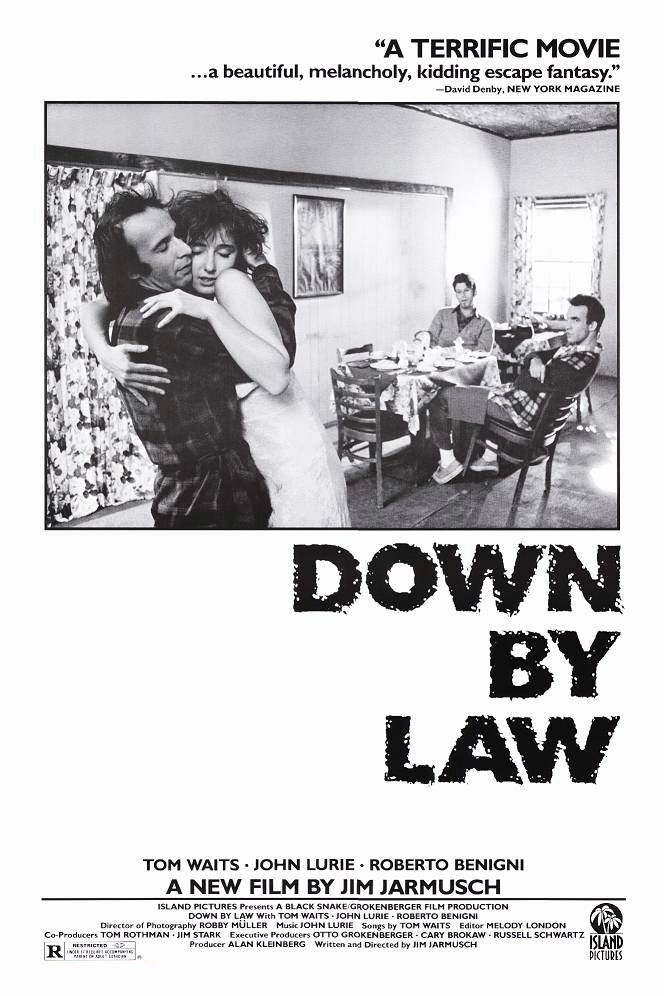
On Sept. 2, IPH’s popular Summer of ’86 series brings to the big screen DOWN BY LAW, a gem from the acclaimed director Jim Jarmusch.
Following the landmark success of his wonderfully minimalist road film, STRANGER THAN PARADISE, independent American iconoclast Jim Jarmusch made DOWN BY LAW, essentially turning a typical noir plot inside out, stretching it into a hangout film of discordant characters and filling it with the contents of, well, a Jim Jarmusch movie.
The story is set first along the seedier streets of New Orleans: A down-and-out disc jockey (Tom Waits, in the prime of his career as one of America’s greatest artists) is framed for murder, and a pimp (Jarmusch’s frequent collaborator, John Lurie) is framed for soliciting a minor. Both are sent to the Orleans Parish Prison, where they are soon joined by an Italian tourist on his first trip to the United States (Roberto Benigni, playing a character named Roberto), who is arrested for manslaughter. It is the story of three individuals who would never cross paths beyond the bars but are forced together, ultimately clashing, bonding and going mad in the same soul-deadening room.
The film opens with widescreen black-and-white images (photographed by the great Robby Müller), announcing the New Orleans landscape and culture from the jump. What is photographed is never the common, commercial New Orleans, but streets, swamps and people in a rolling panoramic view, set to the rumbling murmur of Waits’ song Jockey Full of Bourbon from his seminal album, Rain Dogs. The whole city and all its inhabitants seem down-and-out. But as soon as the characters are brought to the screen, the opening realism dissolves into the bottom of Jarmusch’s concocted pool of competing elements, serving merely as a backdrop for his beatnik poetry sensibility, character personalities that blend like oil and water, and a story that progresses into a quaint fable-like tale somewhere between the respective Americas of Huckleberry Finn and Jack Kerouac.
Roberto is a spirited, curious and amusing individual who brings movement to the trio, which would otherwise stall completely if Waits and Lurie were left alone to beat each other’s head in. He devises an escape that is miraculously successful, leading them into the seemingly endless swamps. The rest is a charming, chaotic, incorrigibly contained American dream.
To frame it as an American dream may be the most interesting way to watch this film. It is perhaps more accurately the underbelly of the commonly touted American dream of prosperity and freedom, depicting imprisonment and continual misfortune quite literally; yet, any thematic translation proves elusive for DOWN BY LAW, as Jarmusch and company take the narratively absurd elements to their natural destination, playing it thoroughly straight without additional commentary, which proves to be tonally amusing. Jarmusch’s films are almost always funny, in a melancholic deadpan tone, and this is one of his funniest. A pimp, an Italian and a disc jockey in metal-toed rockabilly boots, all convicts, all searching for a fresh start, all hoping to stumble upon an open road toward a new life — it sounds like the setup to one of those great old jokes told by grizzled barflies in a dusty saloon.
In the end, the film is about trapping three vastly different personalities in a cell and letting it unfurl where it will. And they travel through the swamps and the spindly, barren trees, into forests where roasted squirrel becomes dinner, before they make it back out again as slightly civilized men. Each character feels, from beginning to end, like a figure you’d vaguely remember from a drunken spree through the Big Easy, or maybe someone you dreamed up at home. Sometimes it’s easier to remember the people along our journey than the journey itself.