
By Travis Mullis
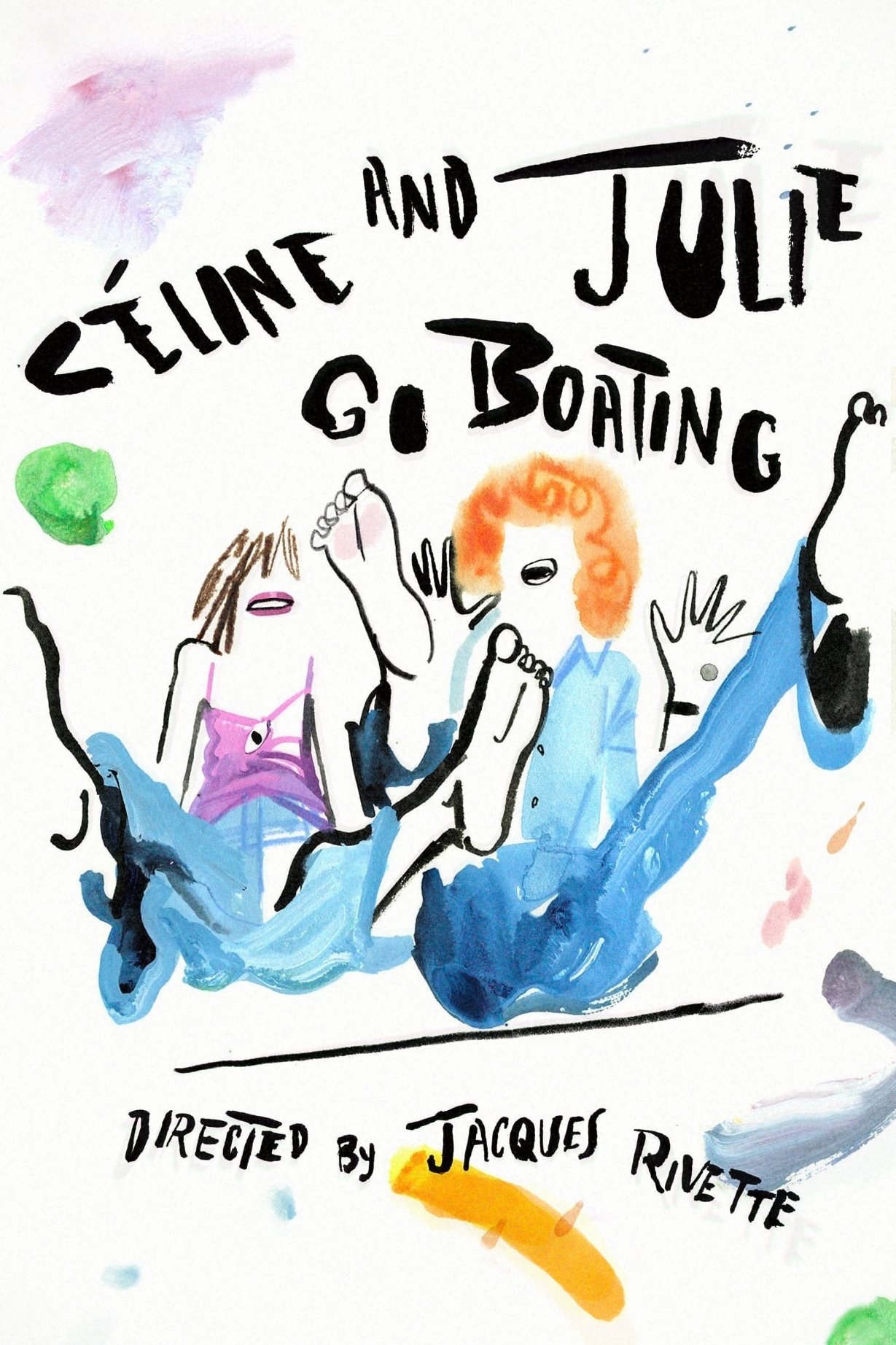
The Independent Picture House is offering a free screening of CELINE AND JULIE GO BOATING on Saturday, Aug. 15, at 7:30 pm, as part of Goodyear Arts’ Wavelengths: Classic Experimental Films series.
A young woman with curly red hair sits on a bench reading from a large red book emblazoned with a pentagram, muttering to herself and drawing symbols with her feet in the sand beneath her. As she reads, she surveys the park around her and notices a skinny, dark-haired woman shuffling across the park, dropping a scarf as she goes. The redhead goes to pick up the scarf and return it to the dark-haired stranger, only to find herself totally ignored. The redhead follows the dark-haired stranger through Paris. So begins CELINE AND JULIE GO BOATING.
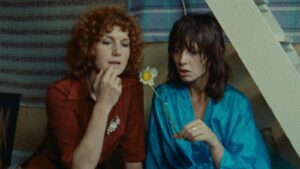
Jacques Rivette doesn’t have the name recognition of Godard, Varda, Truffaut, Rohmer or Chabrol, but his 1974 film, CELINE AND JULIE GO BOATING, offers one of the best meditations on dreams, fantasy, female friendship, and the role of cinema ever made.
Shot on 16 mm handheld cameras, the film runs more than three hours. Rivette is unconcerned with the rigors of editing and painterly composition, letting his characters and their antics grab the viewer and draw them in, making them part of the fun. Logic goes out the window, as does the usual cinematic narrative. Suspense and rigorous plotting are beside the point to Rivette. Scenes unfold slowly, allowing the audience to become immersed in the growing friendship and shared fantasies of Celine and Julie, who start to swap lines and life stories, each inhabiting the other’s role as if rehearsing for a play. The line between fantasy and reality is blurred and distorted to the point that the viewer can no longer discern fact from fiction, but more to the point, doesn’t care to.
As the film proceeds, a strange old house and its even stranger inhabitants begin to take center stage as Celine and Julie venture there, disappear inside and begin to reconstruct the events inside the house from memory with the aid of hard candies. The urge to compare the candies to Proust’s madeleine is almost always irresistible. Rivette is French, after all. But hard candies are also a feature of childhood, and Celine and Julie finally go to the house together to save the child, Madlyn, from the clutches of the antiquated adults in zombie makeup who own the old house, which seems to be stuck in time around 1900. The action inside is something like a film playing continually on a loop. With each trip, Celine and Julie piece a little more of the film together.
Madlyn is saved, of course, and comes to live with Celine and Julie back in 1974. But a strange thing happens. They all go boating on a fine Paris afternoon, and there, in another rowboat that passes them by, are the three adults from the creepy mansion, enjoying themselves and staring at Celine, Julie and Madlyn. What does it mean? Rivette leaves it to the audience to decide.
A skinny, dark-haired woman sits on a bench, nodding off to sleep. She wakes momentarily, surveys the park around her and notices a young woman with curly red hair shuffling across the park, dropping a red book as she goes. The skinny, dark-haired woman goes to pick up the book and return it to the redheaded stranger, only to find herself totally ignored. The dark-haired stranger follows the redheaded stranger through Paris. So ends CELINE AND JULIE GO BOATING. The movie goes on and on, a continual showing.