
By Trent Lakey
In the ordinarily quaint, unassumingly small town of Virgil, Texas (a completely fictional town, mind you), residents and visitors prepare for the sesquicentennial anniversary and a “celebration of specialness” in honor of what is one of the least special towns imaginable across the American landscape. It is a town overrun with exuberant consumerism; a pioneering computer manufacturer that employs many, if not most, of the town’s residents; and countless peculiar, hopeful figures, all lost somewhere within the growing, relentlessly fluid throng of cultural modernity. From our familiar perspective, nothing seems extraordinary about the town.

But, from another point of view — the perspective of an outsider — this little American town, replicated broadly across the country, becomes the definition of unique and eccentric. So goes the premise of the 1986 gem TRUE STORIES, a film seemingly destined for cult status and critical misinterpretation from its inception — which is exactly what occurred upon its release, though it has since been warmly reappraised by successive generations.
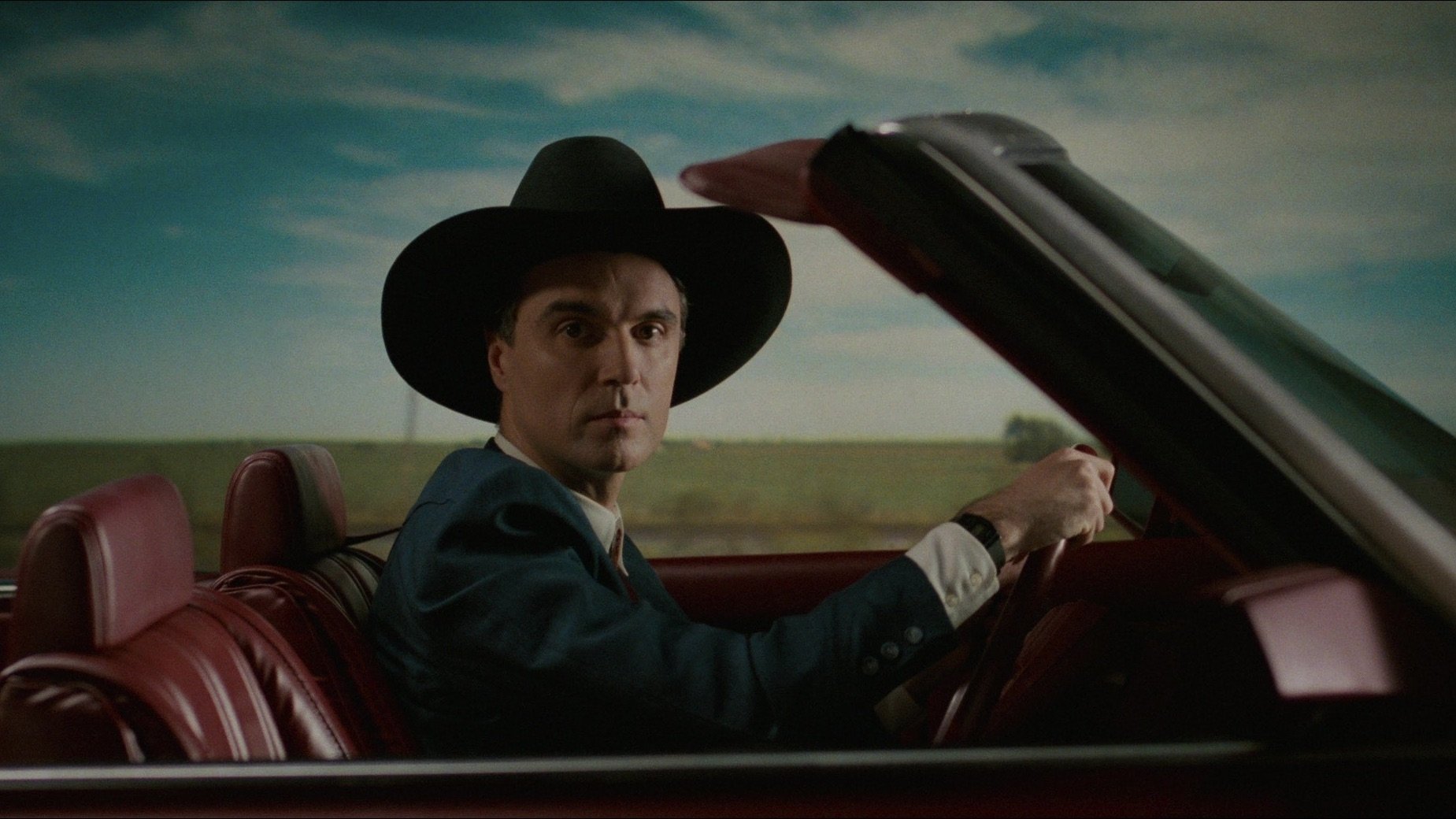
David Byrne, the innovative Talking Heads frontman, co-wrote and directed the film. He also stars as the detached narrator, dressed in traditional Texan garb: dark leather boots, a wide-brimmed cowboy hat, a bolo tie, etc. He is often the only one dressed like he’s in Texas, as the born-and-bred Texans instead wear ’80s attire. Byrne roams the town as a curious, almost omnipresent drifter, observing cultural habits and beloved local events, perusing every surface of Virgil, Texas. All seem to be vessels for the townspeople to project their evolving American dreams, whether it be a shopping mall fashion show where the models are dressed in suits of grass, the patterned brick of ordinary buildings, or children dressed as sophisticated adults; whether it be a dolled-up woman lying about affairs with JFK or Burt Reynolds; or the town’s corporate and civic leader pontificating poetically about work becoming the highest pursuit of our lives. All become distinctly American pursuits of a new kind of life, liberty and happiness.
Drifting in and out is Louis Fyne (the wonderful John Goodman), an employee at the corporation and a self-described “Country Bachelor,” whose sole material and spiritual ambition revolves around finding a wife. He even advertises on local television for a partner to fulfill his matrimonial desires. His presence recurs almost as frequently as the narrator’s as he prepares to perform a song he has written at the sesquicentennial talent show (the Talking Heads song “People Like Us”), the lyrics of which he recites to a prospective wife: “people like us/we don’t want freedom/we don’t want justice/we just want someone to love,” to which she, confounded, declares him a very sad man.
Each roving character, whether present for mere seconds or throughout the entire film, is a vibrant insect in an endless tapestry of American anthropology, enlarged to the size of a giant through Byrne’s curious microscope. Colorful vignettes connect the town’s inhabitants, discovering beneath the surface the peculiarly different ways they search for the same happiness. Everything and everybody is as American as apple pie and infomercials. Nothing is ever derided outright through cheap, acidic satire; rather, it is all accepted gently and cheekily as a wondrously strange, dreamlike land of odd sensations. It is a film that very much resembles a Talking Heads album, with its fixation on ordinary American culture — plain, dull things befitting a small town lost in Texas — showing how simply strange life is in and of itself.
It is horribly easy to dismiss familiar things as ordinary, dull and useless because we think we know all there is to know about them. But when the veil is lifted, perhaps through a film such as this, and our eyes are returned to a sensational state of unfamiliarity, a true experience of life’s ingenuity occurs. That is a true story, stripped of all the facts and knowledge. And that is what TRUE STORIES is here for.