
By Lawrence Toppman
I was the kid who peeped up the magician’s sleeve to see where the dove was kept, the one who sneaked behind the tent flap at the county fair to see if the bearded lady might take off her whiskers. Yet when it came to movies, I wanted illusions left intact.
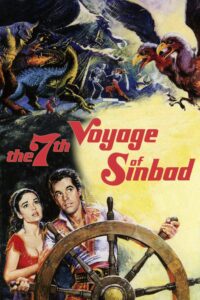
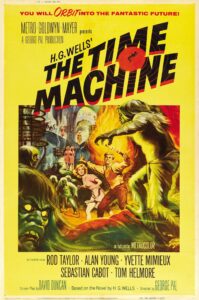 The six-year-old me wanted to believe lumbering Morlocks were decimating the delicate Eloi in THE TIME MACHINE. (My folks hadn’t known the movie depicted cannibalism.) When the gigantic Roc and Cyclops menaced the hero in THE 7TH VOYAGE OF SINBAD, I didn’t pick apart the slightly jerky movements of the stop-motion animation; I sat wide-eyed before a world of wonders on our boxy, primitive color TV.
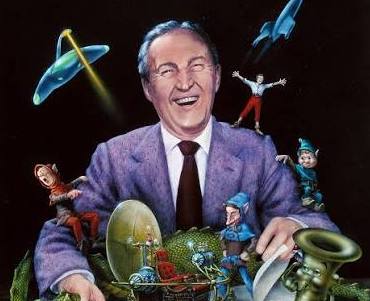
You’ll need that kind of innocence to appreciate The Fantasy Film Worlds of George Pal, a series running Nov. 13-15 at The Independent Picture House. Arnold Leibovit, a filmmaker and preservationist who has spent more than 40 years restoring and presenting Pal’s work, will help you find it.
He’ll be on hand to show his documentary THE FANTASY FILM WORLDS OF GEORGE PAL and talk about the Hungarian expatriate who revolutionized puppet animation in the 1930s and ‘40s, then influenced classic science fiction films of the ‘50s. He’ll also sell signed Blu-rays of Pal’s restored PUPPETOONS and CDs of Russell Garcia’s remastered score for THE TIME MACHINE.
Pal sometimes produced pictures (THE WAR OF THE WORLDS, fourth and final film in this series), sometimes directed them (THE TIME MACHINE), and worked with top-notch special effects designers. One of them, Ray Harryhausen, made his debut with the Pal cartoon short TULIPS SHALL GROW and designed the animation for THE 7TH VOYAGE OF SINBAD and its two sequels.
 But as Leibovit will tell you, Pal’s life was no happy fantasy. The man born György Pál Marczincsák rose to become the head of animation for UFA, German’s most prestigious studio, in the 1930s. Instead of hand-drawn panels, he created three-dimensional animation with puppets and stop-motion photography.
He fled the Nazi regime, first for the Netherlands and then for the United States, and landed in Hollywood circa 1940 with a wife and son and a style of animation that pioneers such as Walt Disney, Walter Lantz and Max Fleischer had never tried.
He’d made 18 PUPPETOON shorts in Europe and would create 45 more over three decades in America. I saw his most famous, TUBBY THE TUBA, on TV as a kid, little realizing he’d also made animated tributes to hip jazzmen Woody Herman and Duke Ellington.
Pal was nominated seven consecutive times for Academy Awards for animated shorts in the 1940s, losing twice to Disney, once to Warner Bros., and four times to Fred Quimby, producer of Tom and Jerry cartoons. Maybe that’s why he started dealing with live humans.
He produced DESTINATION MOON, which won an Oscar for special effects in 1950, and he’d found his niche. Science fiction and fantasy films streamed out of him for 14 years, from WHEN WORLDS COLLIDE (also a special-effects Oscar-winner) to the underrated 7 FACES OF DR. LAO, my favorite film in the first 10 years of my life. Though he won an honorary Oscar in 1944, I suspect he’d have been just as happy to learn the International Astronomical Union named Pál Crater on Mars in his honor in 2010.
Pal continued to work on projects until his death in 1980, but Hollywood had passed him by. He produced only two films in the previous 16 years, the flops THE POWER and DOC SAVAGE: MAN OF BRONZE.
Harryhausen also had his last great moment the year after his friend died, producing and designing effects for CLASH OF THE TITANS. By then, feature-length stop-motion pictures had nostalgia value but were otherwise too unrealistic to speak to audiences. RAIDERS OF THE LOST ARK won the Visual Effects Oscar, as it was now known, for 1981 and set the pattern that hasn’t changed in the last 45 years.
I interviewed Harryhausen during the release of CLASH OF THE TITANS, and he told me that my generation was perhaps the last that would fall in love with movies that were clearly artificial. I’m struggling to recall his words decades later, but he said something like, “You have to let your imagination override your eyes.” If you can do that, The Fantasy Film Worlds of George Pal will carry you to a different universe.