
By Trent Lakey
As part of its Bleak Week: Cinema of Despair series, IPH will screen WERCKMEISTER HARMONIES, a challenging, hypnotic film from Hungary that is considered one of the best films of the 21st century.
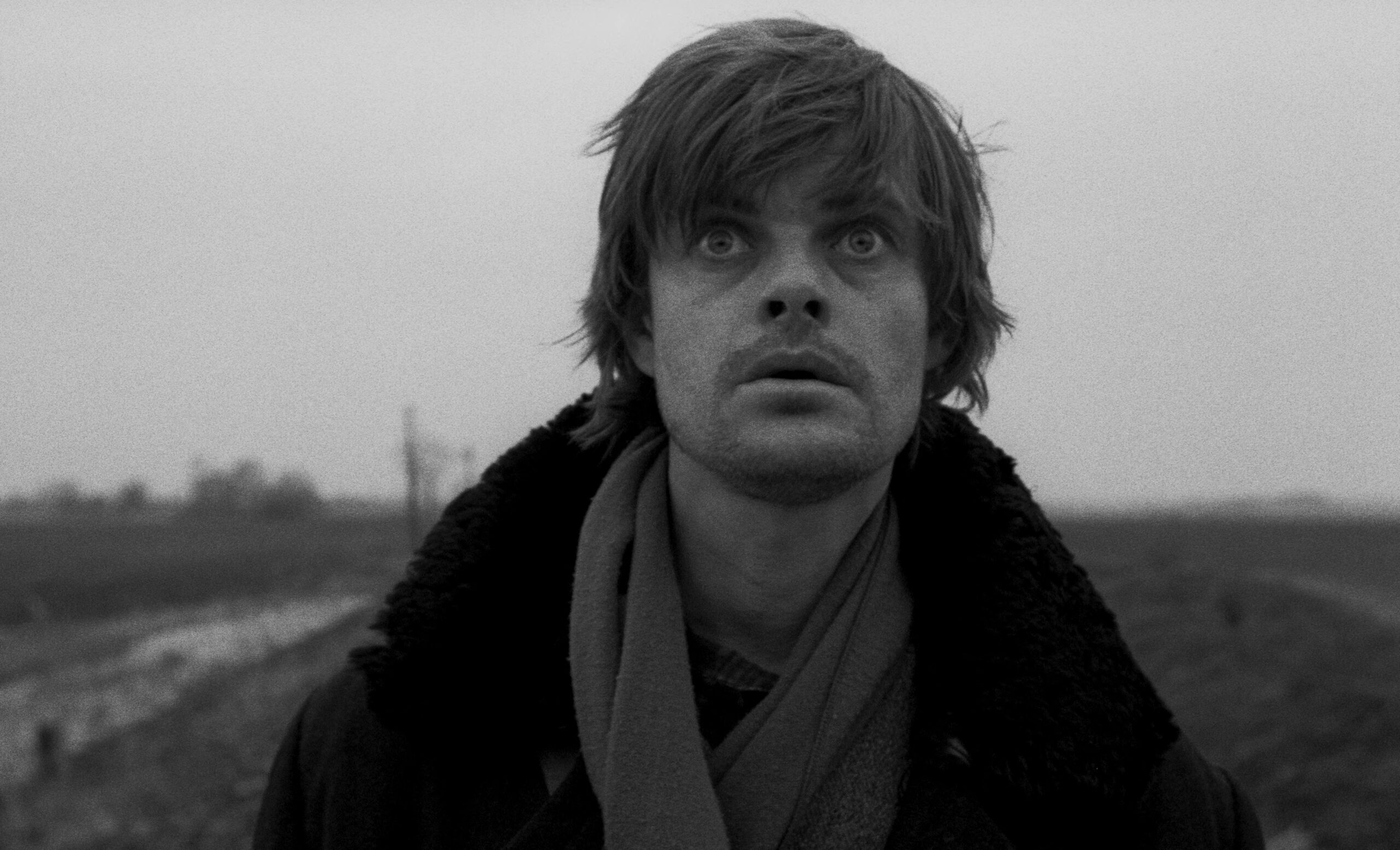
Béla Tarr’s WERCKMEISTER HARMONIES (2001) begins with an unbroken, physical reenactment of a solar eclipse in the village tavern, with a few of the ever-present barflies serving as the Sun, Moon and Earth. János (Lars Rudolph), a young man from an unnamed Hungarian village who wears the sunken eyes of a much older man, orchestrates the revolutions of the celestial bodies, narrating the solar circumstances through detached, poetic description. What begins as a spectacle of passing curiosity becomes an existential reflection on cosmic order. As the sky falls dark and the air grows considerably cooler, all the creatures of the forest and house-trained pets panic in manic confusion: “Are the hills going to march off? Will Heaven fall upon us? Will the Earth open under us?” For a brief spell, all the passages of time, all the movements of life, cease and still. It is as if all reason has abandoned us. But soon the sun’s light returns unobscured to the sky, the creatures return to calm, the air warms and the tavern closes for the night.

Tarr’s film, an adaptation of recent Nobel laureate László Krasznahorkai’s novel The Melancholy of Resistance, follows János and many of the village residents as a strange, portentous tension slowly fills the air with the arrival of a traveling circus featuring a rotting behemoth whale and an unseen but oft-advertised and murmured-about Prince. The circus truck crawls in through the dead of night, seen only by János, and, not unlike the three witches of Macbeth, becomes the indescribable catalyst for tragedy.
The title references the German composer Andreas Werckmeister, whose treatises on musical tuning and harmony propounded the use of equal temperament, which suggested 12 equally toned octaves instead of just the seven notes of the musical scale, introducing five semitones. This would create higher, more perfect harmonies — the most widespread musical system since the 18th century. Mr. Eszter, an elderly music theorist whom János cares for, believes the five half-tones to be unnatural products of an arrogant Werckmeister who wished to possess the harmonies of the gods. According to Eszter, music and all the masterpieces created from the 12-tone octave are built on a false foundation, producing only illusions from an unnatural scale. But even he eventually admits it would be wrong to return to the natural seven-note scale; after all, the world has changed, like returning to the medieval ages after Nietzsche’s pronouncement of a dead God.
Loose, seemingly incongruent threads like these are sewn together throughout, between the rise of the circus attraction and the chaos soon to be sown. The film becomes about pervasive illusions such as the equal-tempered musical scale, the total obscuring of the sun, or the meanings derived from staring into the glassy eye of a rotting whale lodged in a truck. When these illusions spread through an entire community, they become more real than nature. Musical compositions are forever changed, corners of the world lie abandoned by light for a few hours, and mobs of revolt form, resulting in spectacles of senseless violence. Encroaching evil looms and sweeps through the village in great, mystic silence, like a sleepwalking devil, until the crowds in the town square hear the demagogic words of the unseen, unnamed Prince calling for revolt. The status quo is unacceptable, whether in class relations or musical temperaments, but to revolt, overthrow and revise at will is equally unacceptable: It is destruction, sparking only a seeping shame. Thus emerges an eternally binding, existentially confounding dilemma of how to live mired in imperfection.
Tárr’s film, co-directed and edited by his partner Ágnes Hranitzky, is an undeniably bleak, desolate film and a towering modern achievement. The story mires its audience in the worst capabilities of our eternally imperfect societies, making one feel alone, beaten, yet in awe of our ineffable place in the cosmos. Comprised of just 39 shots, nearly all of them transfixing long takes, WERCKMEISTER HARMONIES is a technical masterpiece, lulling one into impossible chaos. It’s one of the few cinematic landmarks of the 21st century. It is a film of dense shadows and eclipses, but the sun always returns following an eclipse, shedding light on our night’s destruction.