
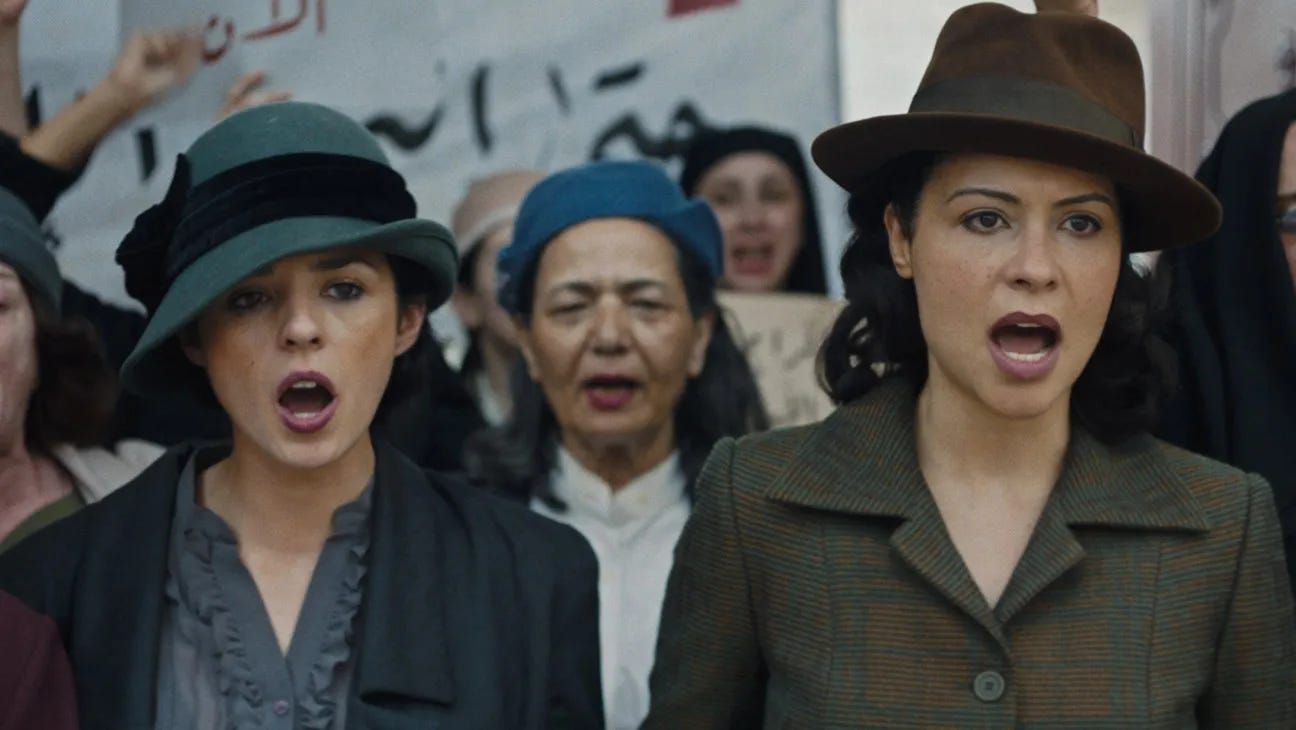
By Matt Cramer
This interview was originally published in Y’all Weekly’s substack. You can subscribe to Y’all Weekly here and Matt at the Movies here.
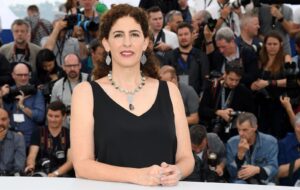 Annemarie Jacir has written, directed and produced over sixteen films. Her films have premiered in Cannes, Berlin, Venice, Locarno, Rotterdam and Toronto. All three of her feature films were selected as Palestine’s official Oscar Entry…Here is my conversation with Annemarie Jacir, writer/director of Palestine ‘36 (which opens on Friday, April 3).
MatM: I read that you’ve envisioned telling this story for years. Why now?
AJ: Well, it’s not really “now”. I’ve been working on it for so long, so I feel like it’s long overdue. But it’s an important story now. I think for as long as I can remember, in my life, my parents’ life and my grandparents’ life, we are just here in the middle of it all again. You know war and occupation, and this struggle to exist. I feel like we’ve really got to tell the stories about the roots of it. It’s a story that hasn’t been told before, and it’s really the origin story in many ways to where we’re at today. I think it’s important to know our history in order to imagine and work towards a better future than this one.
MatM: You wore many hats for this project including writing the screenplay. This was an expansive story covering many conflicts, several years, and multiple viewpoints for a two-hour film. What was your biggest challenge creating a script with so many moving pieces?
AJ: Yeah, it was a challenge. It was a challenge because I didn’t want to do it in the classical way of having one hero character from beginning to end. I didn’t want to have any hero, in fact, and that the place was the hero. Land was the hero. Our home is the hero. So it was tricky because it’s like weaving, and it was tricky to ride. For me, you know, it was like how all of these stories kind of intersect. They’re all experiencing a major event, but in a very personal way, and in very different ways.
So that was the thing about the script to keep it personal and intimate. Then in the editing it becomes something else. After you shoot it, you’re adding certain characters that are taking up more time than others. Creating the rhythm of it. To have a very small role, yet to be able to understand the character.
MatM: You are not only the writer but director of the film. In terms of production, your team was able to film some of the scenes in Palestine. Logistically with daily changing geopolitics of the region, shooting could not have been easy. Did you feel it was important to be on location to tell this story?
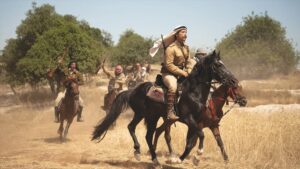 AJ: I absolutely felt it was really important for us. For the team, for the crew, and for the story itself. It was very heartbreaking for me. It was devastating when we had to move the production to Jordan. At some point, my producer describes it. He said, “I had to cut the umbilical cord. You just wouldn’t let go. You wouldn’t, you know, and I just, we’re not gonna be able to film”. It was becoming more and more obvious. So he cut it. And I told him, he didn’t cut it, he just made it longer. Then I came back anyway.
It’s a story about this period, and the fact is Jordan does look different from Palestine. Even though it’s geographically so close, it looks different. The housing, the architecture, the stones, and especially when you’re talking about cities like Jerusalem. There’s no way to replicate thousands and thousands of years. So many different peoples building on top and building on top.
You know, there’s a real depth there, and you feel it. It’s even in the air. It’s like why people get this “Jerusalem syndrome” from being there. I don’t have “Jerusalem syndrome”, but it’s a real thing. It is important for a film to be able to be in the actual place. Also for the team and the film it makes it special. It’s where we live. It’s where we’re trying to build an independent film industry, and you can’t do that if you’re shooting somewhere else
MatM: This cast was incredible and included some amazing veteran actors including Oscar winner Jeremy Irons. I wanted to take a minute to talk about Karim Anaya. He made his film debut playing the critical role of Yusuf. Why was his character important for the viewers to understand the revolt?
AJ: He’s amazing. He does parkour. He grew up in a West Bank City, in Qalqilya, doing Parkour as a way to live. Then he joined the theater, but it’s his first experience on film.