

By Trent Lakey
This year marks the 25th anniversary of John Cameron Mitchell’s HEDWIG AND THE ANGRY INCH, a punk-rock musical odyssey set in the true heartland of America: cheap motels, a chain of low-end diners across the Midwest and the occasional shopping mall. Hedwig (Mitchell) is an East Berlin-born punk singer who, alongside her backing band the Angry Inch, performs personally inspired, narratively reflective punk anthems and rock ballads for a predominantly unsuspecting, unappreciative American middle-class audience comprised mostly of elderly white patrons.
Through the raw power of Hedwig’s music, we are taken on the journey of her personal and physical transformation — from behind the Berlin Wall of her youth to the traumatic relationships that follow her migration to America and the healing she finds in performance.
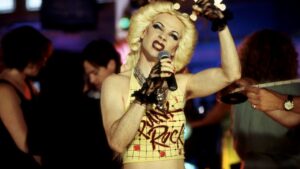
What began as a drag performance conceived by Mitchell and composer-lyricist Stephen Trask morphed into an Off-Broadway stage play in the late ’90s before becoming a critically acclaimed film adaptation that won the Best Director and Audience Awards at the 2001 Sundance Film Festival. The film was far from a commercial success upon its initial release but has since achieved a sustained cult following and earned a place in the Criterion Collection. HEDWIG checks numerous boxes on the test of time: It eschews musical and film conventions in favor of an idiosyncratic story and offers a progressive portrayal of queer identity and gender. It failed to recoup its budget at the box office, yet the story has endured across 25 years, through stage revivals, retrospective screenings and the continued acclaim of new audiences. It seems plausible that its cultural reach has extended further than some more commercially successful films of that same year. (Can anyone truly say they are anticipating the 25th anniversary of RUSH HOUR 2 or Tim Burton’s PLANET OF THE APES?)
Mitchell and his collaborators work throughout the film to maintain a spirit of continual change — an amorphous essence and an aesthetic in flux — befitting the boundary-defying subject at the center of their narrative. The film employs animated interludes, fantastical musical performances, bawdy humor and, perhaps most surprisingly, a cutting dramatic realism that reaches the naked core of its central character, revealing the depths beneath the wigs, makeup, screeching guitars and exhibitionist outbursts. As the film progresses on the back of Hedwig’s perennial failure, the “internationally ignored” star she imagines herself to be finds another kind of success: internal honesty and self-acceptance. Shedding the costumed performance, Hedwig becomes someone new, yet more herself than she has ever been, announcing to the world who she is, whatever that may turn out to be.